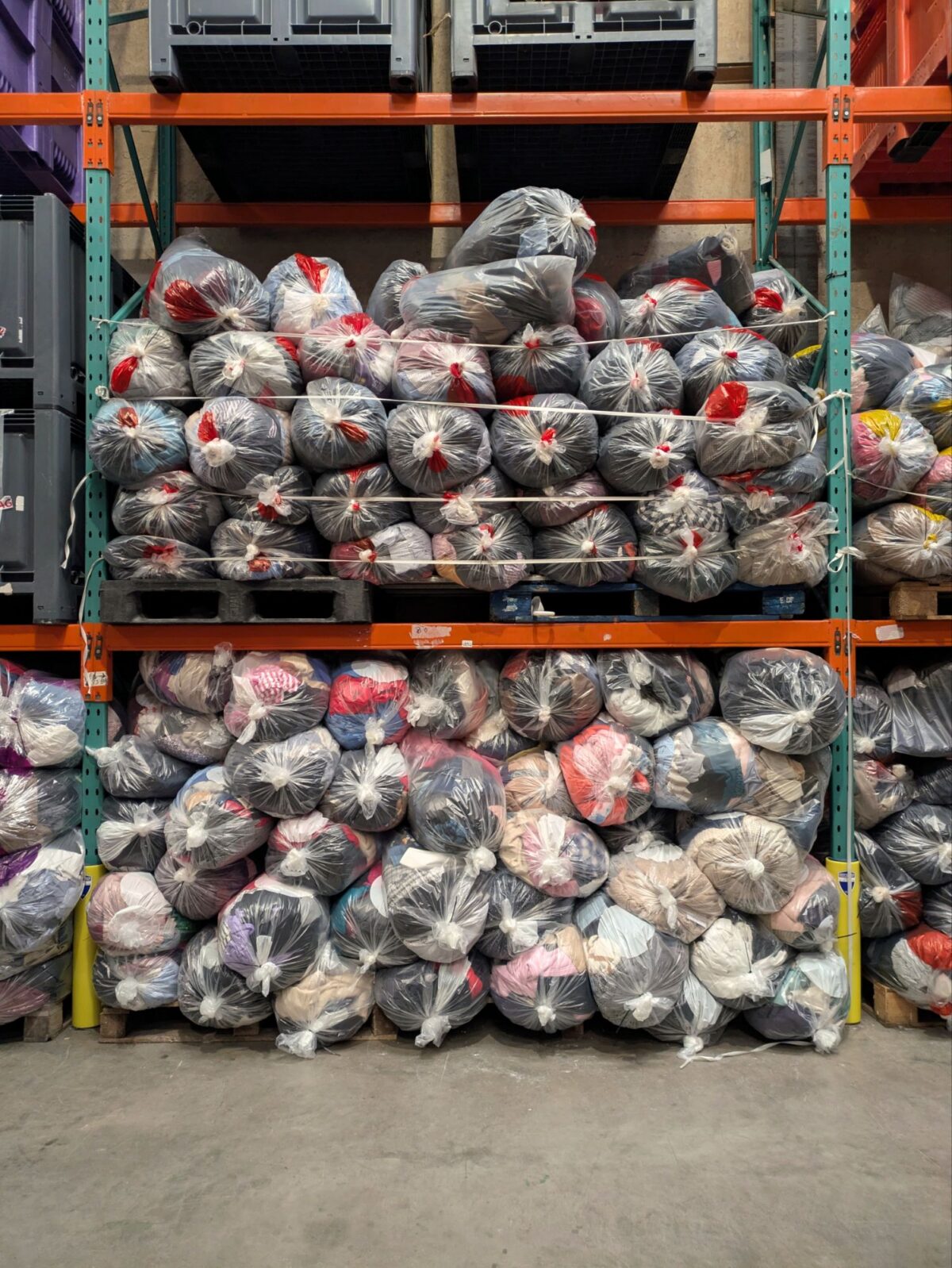
10,500 bags and counting.
This week I got to visit Vision Ireland and tour their warehouse. If you were expecting a dirty, dusty space piled high with sad looking clothes, you would have been surprised. That idea fell away pretty quickly, somewhere between the scale of it, 10,500 bags, and the reality of how it was actually handled. Every single bag opened. Every item touched. Sorted by hand. No drama to it, just a system that kept moving.
Five women worked their way through each piece. There was no sense of things piling up or getting lost. Everything moved on, one way or another. And that was really the point, not just to deal with volume, but to make sure nothing stalled. The wider team carried that same clarity, walking us through each stage, answering questions, explaining decisions, showing how the whole system held together. At one point I asked what happened to the pieces that didn’t sell. The answer wasn’t simple, but it was reassuring. Through a network of partners, items moved in different directions, reused, resold, repurposed. Things that didn’t work in one context were shifted into another. It felt less like sorting and more like redirecting.
We then stepped into the e commerce space and it was a different energy altogether. The volume dropped away, even if only slightly. Pieces had more space. They were looked at more closely, styled, photographed, given a second life that felt considered rather than incidental. It edged closer to retail as we’re used to seeing it, clean, selective, intentional. In another warehouse space, rails were being built out for pop ups, not thrown together, but properly assembled, each one with a sense of shape to it. Again, it was less about clearing stock and more about how it was experienced when it landed somewhere new.
And not everything started out as second hand. There were samples in the mix, alongside deliberately sourced vintage. Across everything, there was a steady effort to challenge what second hand looked and felt like, and if you were new to second hand shopping, it likely would have started to shift something. The idea that this was secondary, or lesser, or purely functional didn’t quite hold up when you saw the level of care running through it.
But the scale never really left you. 10,500 bags, and counting, all of it needing time, labour, decisions. You could feel how well the system worked. You could see the thinking behind it. But it was hard not to wonder, not just for Vision Ireland, how far something like this could stretch. At what point did the volume outpace even the best version of this?
And what does that say about everything still to come?
Jo
